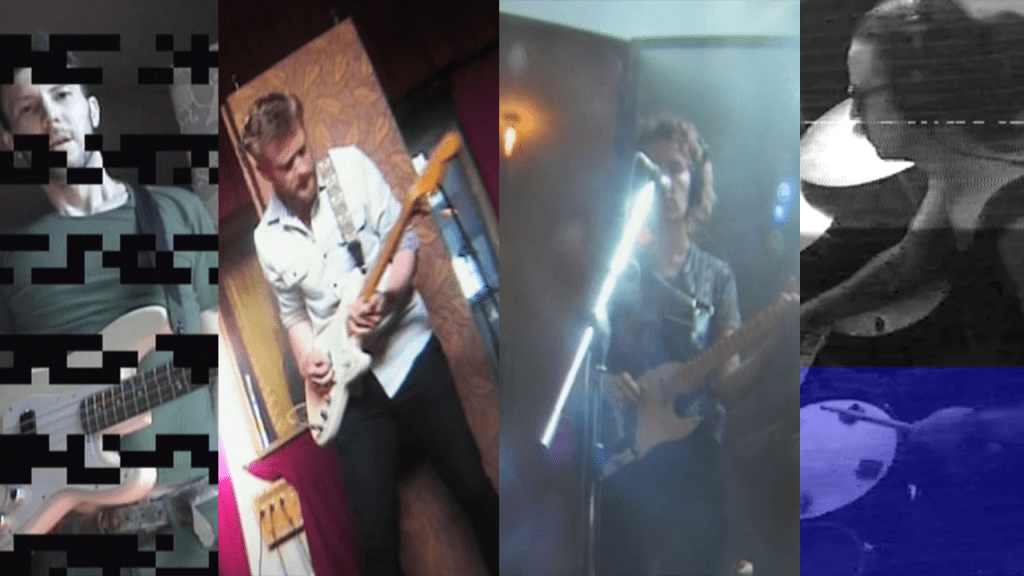
Image: Merle Blanc – supplied.
Author: Melody Menu
To borrow a phrase from Howard Moon, Melbourne band Merle Blanc are genre spanners. Their sound is spacious, containing multiple moods and styles and channelling eras gone by from shoegaze and psychedelia to stoner rock and dream pop. Guitar lines are soaked in reverb and delay then set alight.
In their new Live at Bakehouse videos, the band recorded a number of intuitive and introspective songs at Bakehouse Studios, which form the first listen to further upcoming releases. The videos are filmed and edited lock-down style and you can imagine the band members in separate rooms in separate cities, coming together to make music online to connect and find some commonality in the chaos. This feels apt for a band that was dreamed up during one of Melbourne’s several lockdowns with plenty more material up their sleeves.
Singer and guitarist Angelina Crutchfield tells us about recording and mixing the band’s Live at Bakehouse videos, trusting her instincts in the studio, and what we can expect next from Merle Blanc.
Please introduce us to Merle Blanc – who plays what and how did you all meet?
I’m Angelina I play vocals and guitar, Tyson plays bass, Jamie plays drums and Tomas is our lead guitarist. Our friend and former bandmate Aidan also performs in the videos on keys, he is now focusing on his solo project ‘Honest Dan’. I initially met everyone online through musician’s social groups and apps, I think it was towards the end, or when we were in and out of Covid. I remember Tom sending me an audition tape and he was in his pyjamas, lol.
How does your experience of being an audio engineer affect your music? Do you mix Merle Blanc’s music yourself or is this a more collaborative process with the band?
I mixed the Bakehouse recordings and intend to keep doing this work myself. Tyson is also an engineer so having his input or collaboration is something worth exploring in the future as well. Learning how to mix and produce arrangements has been empowering, I’ve always had strong instincts about how I want things to sound, but didn’t know how to execute them or communicate them well to other engineers/producers. My ears being attuned to details like this now is something I need to keep in check as well though, because at shows the goal of live music isn’t necessarily to sound like a record.
What are the essential elements that make up a Merle Blanc song?
The key ingredient for me is always going to be a good song. You can shuffle any kind of stylistic choices around solid song-writing. Sonic signatures that seem to be emerging in our work are dynamic shifts, creative guitar layers and unconventional song structures. I avoid as much as I can, expressing the same sentiment or mood repeatedly in the vocal, as that can be really tedious to listen to. I love performing the songs that are cheerful or contain humour just as much as the dark and sombre ones.
Take us through the creative process for the Live at Bakehouse videos – what was it like to record at Bakehouse, and why was VHS/VCR your chosen medium?
We have rehearsed at Bakehouse before so I knew it was a good sounding room, and the recording engineer we worked with Errol was a total professional that I would definitely consider working with again. VHS is more the chosen medium of the videographer we worked with, Haiden. I’m familiar with his work because we went to uni together and I was always impressed by his passion for film, off-beat aesthetics and the unique way he puts things together.
What is one of your favourite moments or highlights from the Bakehouse videos?
I love what happens with the natural lighting throughout the footage. The way it bounces off guitars, cymbals and faces as we move around, as well as sequences where band members are cast in shadow, is so beautiful to look at and it was very fun to edit and layer these sequences together. You can see this happen particularly in Tell You and Morning Light.
What is next for Merle Blanc after Live at Bakehouse?
We are currently writing a hard rock album (with elements of stoner rock, metal and garage rock), and want to release a single this year.
It’s interesting that the band have released live versions of your songs before recording studio versions. What was behind this decision and how do you think it will it affect the final studio versions?
I think it will benefit future studio versions as these can be used as pre-productions. It gives us a clearer idea of how they might fit on a record and anything that worked or didn’t work in the actual writing and performance of the music. As we have a lot of stored material, the intention was to release some of it in way that felt like we weren’t committing to official versions. I think I wanted to buy some time in a way because I want any studio releases to have really high production and mixing standards, and we need more time to figure that all out.
What is your vision for Merle Blanc?
I want Merle Blanc to become a touring band that technically and artistically does great work.
 Melody Menu