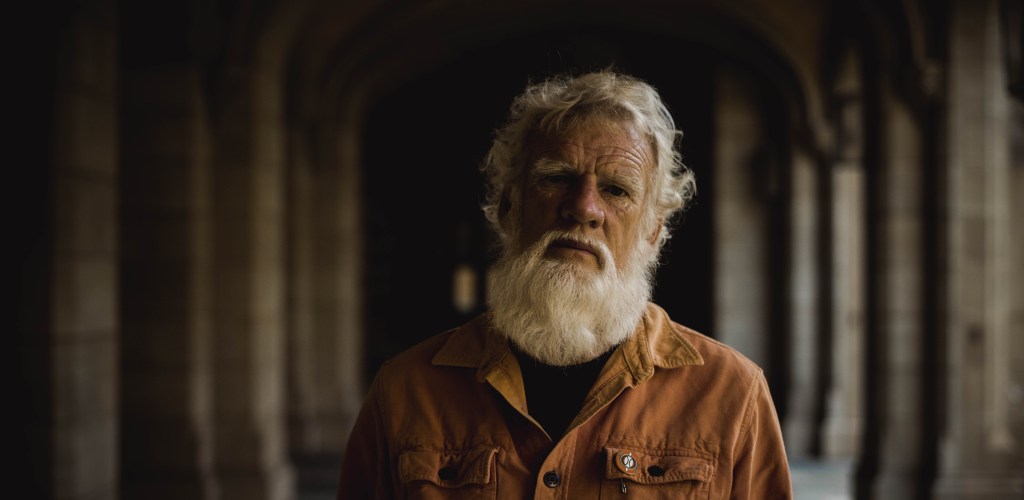
Image: Bruce Pascoe in The Dark Emu Story – supplied.
Author: Melody Menu
Leaving the State Theatre after the premiere of The Dark Emu Story, everyone must have had the same idea. We all wanted a little more of the film’s magic, which had just ended with a click of Stan Grant’s fingers. But we were left to order it in or try to find a dogeared copy from a local library instead. Dark Emu, the book that has sold over 250,000 copies, was out of stock in book stores across the Sydney CBD.
In the film, writer Benjamin Law describes running into Dark Emu author Bruce Pascoe as akin to a ‘rockstar moment.’ And as the film rolls through footage of innumerable books being manufactured and bound, interspersed with incensed news footage and talking heads featuring academics, supporters and critics alike, it’s easy to view Dark Emu as a cultural phenomenon. Yet even as Pascoe’s book has initiated vital discussions, Pascoe has been demonised for introducing these new ideas and perspectives, to the extent that he was investigated by the Australian Federal Police.
“[Dark Emu] really opened a great can of witchetty grubs.” – Stephen Page, Artistic Director and choreographer, Bangarra Dance Theatre
Published in 2014 and raking in awards and shortlists since, Dark Emu was originally subtitled ‘Black Seeds: Agriculture or Accident?’ and introduced a new perspective of Aboriginal and Torres Strait Islander history and contexts in pre-colonial Australia. Professor Marcia Langton AO describes the book as “shifting the paradigm in viewing Aboriginal and Torres Strait Islander peoples from savages to fully fledged human beings.” Through exploration of early settler diaries and other texts, Pascoe puts forward the idea that Australia’s First Peoples were historically observed as being highly skilled agriculturalists, food producers, engineers, and makers of a vast array of tools, techniques, and objects; sophisticated practices that cannot be contained by a reductive ‘hunter-gatherer’ label.
The Dark Emu Story continues the book’s research through case studies of forward-thinking Aboriginal and Torres Strait Islander ingenuity, sustainability, engineering, and food production such as the Brewarrina Fish Traps, traditionally known as Baiame’s Ngunnhu and thought to be one of the oldest built structures in the world; as well as the structures and quarries found in Mithaka Country, Queensland. These countries ripple across the screen in astonishing colour, daring the viewer to question everything they have been taught about Aboriginal and Torres Strait Islander history and agency in pre-colonial Australia. Speaking to the proliferation of grinding stones found in Mithaka Country, Narelda Jacobs OAM invites the viewer to imagine people grinding native grains to make flour. This is turned into mouthwatering reality as we are later shown footage of dough made from native grains sourced from Pascoe’s farm being stretched and pulled luxuriously before being baked into golden scored loaves. Here, a tour of Pascoe’s farm opens dialogue on the qualities of native grains and their potential for robust commercial use – especially as most of them are gluten free.
Food is at the heart of The Dark Emu Story, from the proposal of Australia’s First Peoples being the world’s first bakers, to discussing the digging, harvesting and sowing of murrnong yams, a botanical illustration of which garnishes the cover of the current edition of Dark Emu. The film posits that Indigenous Australian foods could become highly sought after if we worked as a community to acknowledge and cultivate these flavourful and ultimately more sustainable foods – while also protecting food sovereignty and acknowledging these foods as one of many ways Aboriginal and Torres Strait Islander people continue to care for Country.
Alongside its culturally nourishing message, the film is clear-eyed about the cost of challenging the national narrative of Aboriginal and Torres Strait Islander history. Pascoe discusses the devastating impact of the Australian Federal Police investigation on his life – something that was taking place while he was also volunteering as a firefighter during the Black Summer bushfires. The investigation, which arose from baseless claims, was later dismissed by the AFP; but the trauma of such a public and political attack is not forgotten. ‘Farmers or Hunter-Gatherers? The Dark Emu Debate’ co-author Peter Sutton also makes a surprising appearance as one of Bruce Pascoe’s most vocal critics. In the film, he acts as a built-in controversy checker, reminding the audience of the specific suggestions and concepts that have Dark Emu debaters so outraged. At one point, Pascoe and Sutton’s polite arguing garners a big laugh from the audience for its surreal devolution into semantics – particularly of the meaning of the word ‘sophisticated’ – but is a real reminder of the inability of some to want to listen to new perspectives and ideas.
Something that is repeated throughout the film is how much Pascoe wants young Aboriginal and Torres Strait Islander people to feel proud of themselves and their ancestors, with the acknowledgement and respect of sustainable food farming, cultivating and care being a key way forward. The Dark Emu Story challenges us to rethink the history curriculum and to bring it into line with what Aboriginal and Torres Strait Islander and allied educators are already doing to raise awareness and move towards reconciliation. With the referendum on the Aboriginal and Torres Strait Islander Voice to Parliament on the horizon, this is well worth keeping in mind.
The Dark Emu Story (2023) – directed by Allan Clarke and produced by Darren Dale, Belinda Mravicic, and Jacob Hickey. Shown on the 18th of June 2023 at The State Theatre as a part of the 70th Sydney Film Festival.
 Melody Menu