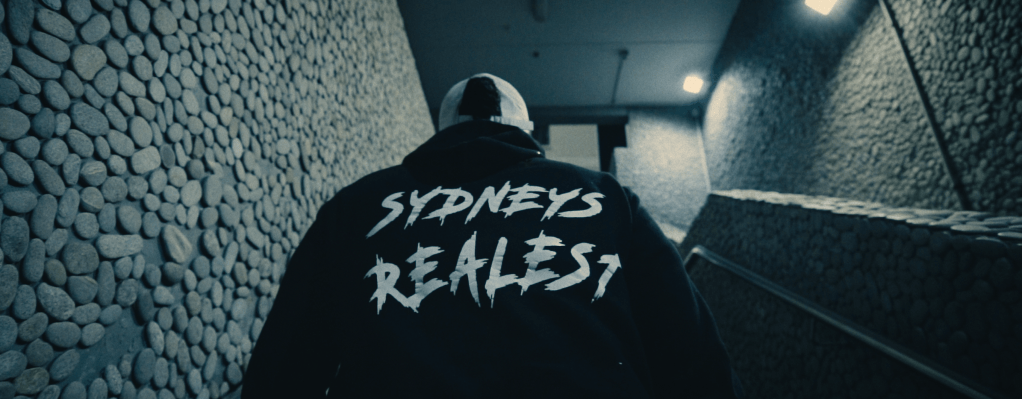
Image: ONEFOUR: Against All Odds film still – supplied.
Author: Melody Menu
Compare the pair: two events at the ICC for SXSW Sydney. Same demographic of music lovers and creatives, same anticipation and excitement from crowds of people. One event has metal detectors, mandatory bag checks and a visible police presence. The other has none of these hoops to jump through, just a long queue of excited fans who are slowly funneled into the Darling Harbour Theatre with their bags and drinks. The first is the world premiere of ONEFOUR: Against All Odds on the Western Sydney band ONEFOUR, the other is an in-conversation event with Chance the Rapper moderated by Poppy Reid. So why the different levels of security?
It feels like everyone knows everyone at the world premiere of ONEFOUR: Against All Odds. Every second person is clasping hands and embracing, waving to friends, or else scanning the audience at ICC Sydney for a particular person. There are cheers and applause for loved community members such as Esky Escandor, Hau Latukefu and ONEFOUR’s manager Ricky Simandjuntak as they make an appearance on-screen, and applause for Spenny as he commits to performing in NZ while without his band mates, refusing to be shut down, showing the very real emotion and inspiration and camaraderie that the band exude. It’s this kind of community that is such a big part of ONEFOUR’s music, this film, and this premiere.
These themes of community and compassion continue to resonate throughout the week at SXSW Sydney between the film premiere, the (De)criminalising Hip Hop panel at the Powerhouse Museum and in Chance the Rapper’s Keynote discussion on the 50th Anniversary of Hip Hop. The general consensus is that Hip Hop is inherently empowering to people, particularly from marginalised backgrounds, which also has a direct link to Hip Hop being over-policed and overly-scrutinised despite the extensive positive impact it has for the community around the world. Throughout the week, the strength and resilience of the Hip Hop community are on full display.
“The beats allow you to feel, think, imagine.” – Nooky, introducing Chance the Rapper
As Ricky mentions in the (De)criminalising Hip Hop panel, ONEFOUR and others continue to inspire the people in their community, particularly the kids who go on to become aspiring musicians, videographers, stylists and athletes because they have seen it done before. Joel Duncan of Mixtape Madness echoes this in the panel, mentioning Stormzy’s publishing company for young creatives and buying a football club to further support the community, as well as Krept and Sasha Ellese’s skincare line for babies which is ‘absolutely booming’ across the UK. Philanthropy and advocacy is also a significant aspect of Chance the Rapper’s keynote address, as he discusses raising millions for public schools and mental health in Chicago, ‘the most geographically segregated city in America’ through his not-for-profit SocialWorks.
“Art, like Hip Hop, is a liberation tool and it’s meant to speak to people…artists are people that communicate at the highest level.” – Chance the Rapper
Again and again, throughout the week, there are stories of how Hip Hop artists are targeted around the world, locally in the case of ONEFOUR’s J Emz, Spenny, YP, Lekks and Celly by the NSW Police’s Raptor Squad; in the UK as explained by Joel Duncan through Project Alpha; and through continued marginalisation and surveillance. In the film, Detective Superintendent Jason Weinstein describes Raptor’s actions as ‘lawfully harrassing’ ONEFOUR, a term he has used in a previous ABC News article where he has further explained: ‘you’re innocent until you are proven guilty so if you’re being targeted [that] has almost reversed that mantra to being guilty until proven innocent.’ Similarly, Joel explains how the police ‘blamed high knife crime on drill music’, enacting Criminal Behaviour Orders against drill artists to keep tabs on them to the extent of requiring lyrics to be approved by police. Our equivalent in Australia is a Firearm Prohibition Order, which Ricky describes as an invitation to raid your house at any time unannounced; something that has been placed on each member of ONEFOUR ‘for life’.
So how can a person, a community, a group of music fans or a whole city see and be inspired by one thing, and the NSW police can see something so completely different and threatening? It all seems to come back to a matter of perception. As mentioned in a recent article in The Conversation by panel members Murray Lee and Toby Martin along with Jioji Ravulo, ‘the story of ONEFOUR has turned police into musicologists and musicians into criminals.’ As Vyva Entertainment Director Vyvienne Abla explains in the (De)criminalising Hip Hop panel, through the ‘hundreds of thousands if not millions invested into [policing] one group…it’s saying that what you’re doing is wrong’ if you choose to position yourself within Hip Hop.
“Context is everything…there’s so many layers to us.”
– Vyvienne Abla
The film is also about the tides of censorship and the particular burden placed on artists of colour. Who gets to decide which music is violent but acceptable, and which music is violent and not? In the film, as heartbreaking footage shows a young YP leaving gaol looking broken and describing debilitating anxiety at getting out, one person might see a criminal, another might see a young person acting and reacting as a result of the cards he has been dealt at birth, and another may yet see someone trying to turn their lives around in the face of a system that is more about degradation and punishment than actual rehabilitation. In this way, director Gabriel Gasparinatos shows Mt Druitt in Western Sydney as an intrinsic character in the story of ONEFOUR; at the same time a family member, friend and albatross.
“We had to share our truth. A story about loyalty and love and where we’re from. We had to shed light on experiences we had to go through throughout our career.” – J Emz, following the film screening
The resounding message between the three events is opening yourself up to the stories and experiences of other people that might differ to yours and this repeatedly comes up in response to the recent ‘No vote’ to the Indigenous Voice to Parliament referendum. Vyvienne Abla thinks of it as a ‘racist no’ and encourages people to listen, accept and advocate for people, even if you can’t completely relate to their experiences. This is echoed by Chance the Rapper, who speaks incredibly thoughtfully and knowledgeably on the referendum despite the distance between countries: ‘we have to get to a point where we listen to the voiceless people’, even when it means leaning into the ‘voice of defeat.’ This is the heart of intersectionality, where people of all backgrounds are welcome and celebrated within Hip Hop.
ONEFOUR: Against All Odds will be streaming on Netflix from Thursday the 26th of October.
 Melody Menu